
Sections in this exhibit
-
1
Section 1 Choosing Sides in Revolutionary AmericaSection 1
After Congress approved the Declaration on 4 July 1776, printed copies and public readings spread its message across the former colonies. Hearing and seeing its words made independence real for many Americans, even as reactions ranged from celebration to uncertainty and opposition.
-
2
Section 2 The Gamble for a New FutureSection 2
Choosing independence in 1776 was a risky and deeply personal decision. Different people supported the Revolution for different reasons, each taking a gamble on what a new nation might become.
-
3
Section 3 The Search for ProtectionYou are here
For many people in 1776, staying loyal to Britain was a search for protection, stability, or freedom. Loyalists made their own choices based on fear of disorder, defense of their communities, or hopes that the British Empire offered a safer future.
-
4
Section 4 The Middle GroundSection 4
Many people tried to remain neutral during the American Revolution, but neutrality was difficult and often dangerous, especially for Quakers. Their experiences show how survival, belief, and circumstance shaped choices in a divided society.
The Search for Protection
For many people in 1776, staying loyal to Britain was a search for protection, stability, or freedom. Loyalists made their own choices based on fear of disorder, defense of their communities, or hopes that the British Empire offered a safer future.
Loyalty as Protection
For between around one-fifth to one-third of the people living in the 13 colonies in 1776, the Declaration was a threat. It marked an end to law and order and threatened to upend their world and lives.
These people, known as Loyalists, or “Tories,” did not always support Parliament’s actions in the 1760s and 1770s. Many future Loyalists were members of protest groups during the imperial crisis, including the Sons of Liberty. At the same time, they believed that the British Empire offered greater safety, more justice, and a better future.
The Voice of Reason
Charles Inglis was assistant rector and rector of Trinity Church in New York City. Born in Ireland to a family of ministers, his loyalty was spiritual and political. He had sworn a holy oath of loyalty to the British monarch, as head of the Church of England. Breaking that oath was a sin.
© National Portrait Gallery, London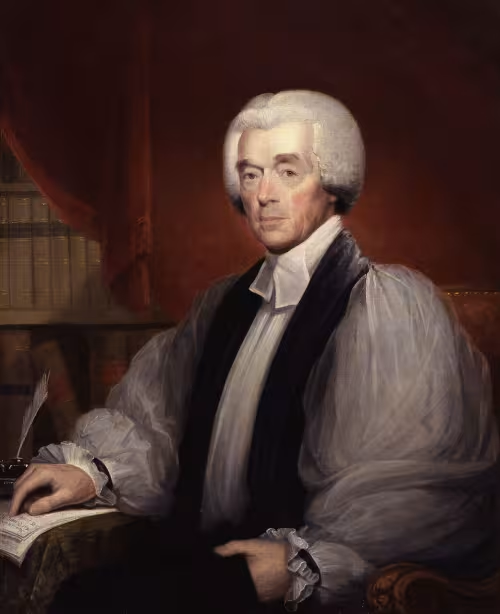
Charles Inglis
Charles Inglis
Loyalist minister who rebutted Thomas Paine's Common Sense and became the first Anglican bishop in British North America after the Revolution.
Charles Inglis, a rector at Trinity Church in New York City, penned several documents in support of the British king, whom he had sworn a holy oath of loyalty to as the head of the Church of England.
When Thomas Paine’s Common Sense began sweeping through the colonies, mobilizing support for independence, Inglis took up his pen to offer an alternative. He wrote a sharp rebuttal entitled The True Interest of America Impartially Stated, arguing that the colonies were too young and weak to survive alone. Independence would “stop the mouths” of their friends in Britain who wanted to help them.
Before that pamphlet, Inglis wrote The Deceiver Unmasked.
Members of the Sons of Liberty thought the pamphlet was so punchy that they reportedly seized and burned it. Despite this clear threat and message, Inglis refused to back down or stop praying for George III during his church services.
Sons of Liberty
Sons of Liberty
Colonial activists network opposing British taxation. Organized protests including Boston Tea Party, mobilizing resistance for American independence.
The Declaration marked the start of a civil war for Inglis, and he wanted to stop it. He later wrote other loyalist documents for the British army that were published in the local press.
Extract from Charles Inglis's "True Interest of America Impartially Stated," c.22–29 June 1776.
Extract from Charles Inglis's “True Interest of America Impartially Stated,” c.22–29 June 1776.
The Crown as a Border: Sovereignty Defenders
Some Indigenous nations believed the Patriot cause was a direct threat to their ways of life. While the Declaration targeted “merciless Indian Savages,” George III had, at least on paper, tried to stop white settlers from taking Indigenous lands through the 1763 Proclamation.
Choosing the Stronger Ally
Joseph Brant, also known as Thayendanegea, was a man of two worlds. Educated in colonial schools and fluent in English, he understood the American “Patriots” better than almost anyone. He knew that the Revolution could become a serious threat. The Americans, he worried, could view Indigenous land as their own.
© The Trustees of the British Museum. Shared under a Creative Commons Attribution-NonCommercial-ShareAlike 4.0 International (CC BY-NC-SA 4.0) licence.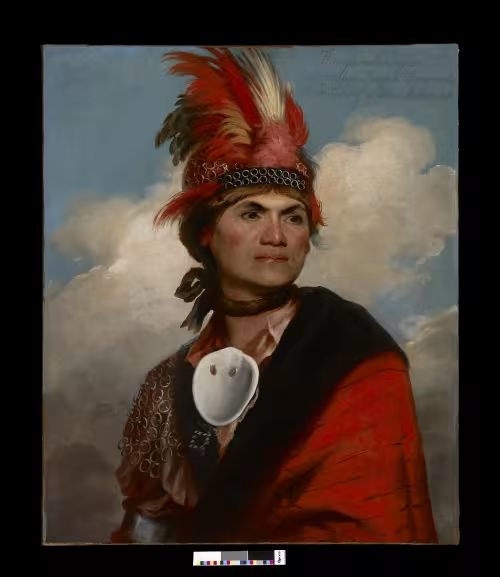
Joseph Brant
Joseph Brant
Mohawk leader who commanded Native forces for the British during the American Revolution and later established the Grand River settlement in Ontario.
Thayendanegea, also known as Joseph Brant, believed that the rebels could become a serious threat and view Indigenous lands as their own.
In 1775 Brant traveled to Britain, where he met George III and secretary of state George Germain. He did not travel as a British subject; rather, he was there in a diplomatic capacity. His most powerful argument for loyalty became when he warned his fellow chiefs that neutrality was a death sentence.
The Cleveland Museum of Art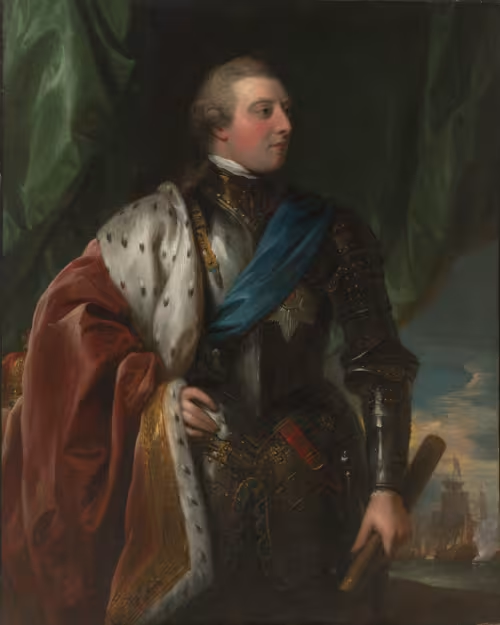
George III of Great Britain
George III of Great Britain
British monarch who reigned for six decades, overseeing Britain's loss of American colonies and the defeat of Napoleon, while battling mental illness.
From the New York Public Library. View in the NYPL's Digital Collections.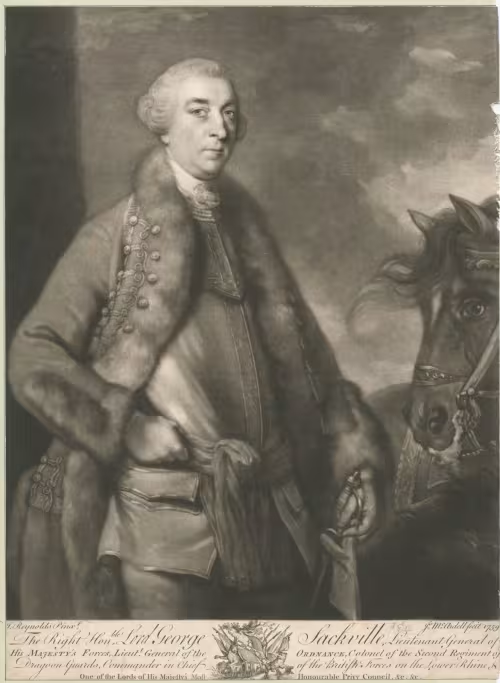
George Germain, 1st Viscount Sackville
George Germain, 1st Viscount Sackville
British secretary of state for the colonies who directed military strategy during the American Revolution, including the Hudson Valley campaign and the relief of Quebec.
According to the Seneca leader Tah-won-ne-ahs (Chainbreaker), Brant argued that if the Indigenous leaders tried to stay out of the white man’s war, they would be crushed by both sides. He saw only one path to survival.
Courtesy of the RMSC. Rochester, NY.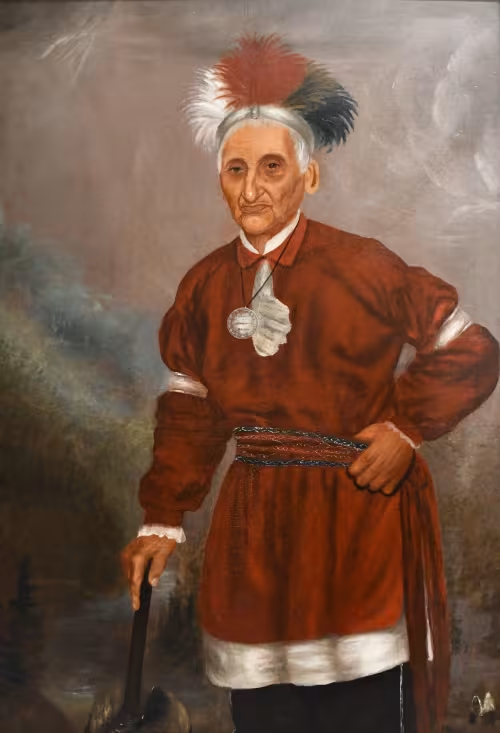
Chainbreaker
Chainbreaker
Seneca war chief who fought in the American Revolution and won the landmark Supreme Court case Seneca Nation v. Pattison, preserving tribal lands.
Seneca leader Tah-won-ne-ahs, also known as Chainbreaker, recalled Brant arguing that neutrality in the war would only invite chaos.
Joseph Brant on Indigenous Allegiances, as recalled by Chainbreaker, c.May 1777.
Joseph Brant on Indigenous Allegiances, as recalled by Chainbreaker, c.May 1777.
Diplomacy and Influence
While Joseph was the face of Mohawk diplomacy, his sister Molly Brant (Konwatsi'tsiaienni) was the backbone of their political influence. Born into an important family, Molly was recognized for her talents in both Mohawk and British circles.
Though she was likely not a formal “clan mother,” her power was undeniable. For 15 years, she was the partner of Sir William Johnson, British Superintendent of Indian Affairs. She was his “faithful housekeeper” and a diplomat who managed the relationship between the Crown and the Confederacy.
Molly Brant
Molly Brant
Powerful Mohawk leader with political influence across Iroquois, British, and colonial spheres during the American Revolution.
Daniel Claus to Frederick Haldimand, quoted in her American National Biography entry.
British officials knew that Molly was the key to the alliance, as one of Johnson’s subordinates noted.
Molly soon became an active intelligence agent. After the war broke out and her home was surrounded by “Rebel Committees,” she stayed on her land, running a trading store and providing food to refugees exiled to Canada.
Her most decisive move came in August 1777. Molly discovered that 800 American rebels were marching to attack Fort Stanwix. She dispatched Mohawk runners to warn the British. Because of her quick thinking, they were able to ambush the rebels at the Battle of Oriskany, leading to a Patriot defeat.
Molly’s loyalty was also deeply personal and religious. Like Charles Inglis, she was a member of the Church of England. She saw the king not just as a political ally, but as the head of her faith. Her “Search for Protection” was a search for a world where her religion, business, and people’s land were safe under the Crown.
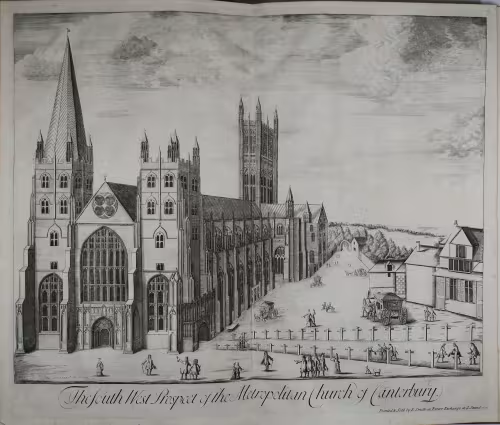
Church of England
Church of England
England's established Christian church, separated from papal authority in 1534 under Henry VIII, blending Catholic and Protestant traditions.
The war was brutal. A Patriot invasion eventually burned the Mohawk fields and drove Molly and her children into exile. But the British did not overlook or forget her contributions.
The Crown granted Molly a house and a pension in Ontario. She spent her final years as a respected community leader. She built a new life in a world that remained loyal to the king.
Freedom Through the British
The Declaration of Independence threatened many people’s lives, and it did not promise liberty or equality. While Patriots gambled on a new future, others looked to the British for protection.
Risks for Freedom
The Declaration of Independence proclaimed the American Revolution was fought for “liberty,” but that did not apply to people who were enslaved. But many soon realized that the British offered a path to freedom that was otherwise unavailable to them.
In November 1775 Virginia governor, John Murray, 4th earl of Dunmore, issued a proclamation promising freedom to anyone who was enslaved by a Patriot if they joined the British forces. By the end of the year, over 300 people had joined Dunmore, forming the Royal Ethiopian Regiment, which grew to 800 men over time.
National Galleries of Scotland collection. Photo, National Galleries of Scotland. Photograpy by Antonia Reeve. Purchased 1992 with contributions from Art Fund and the National Heritage Memorial Fund. View at the National Galleries of Scotland.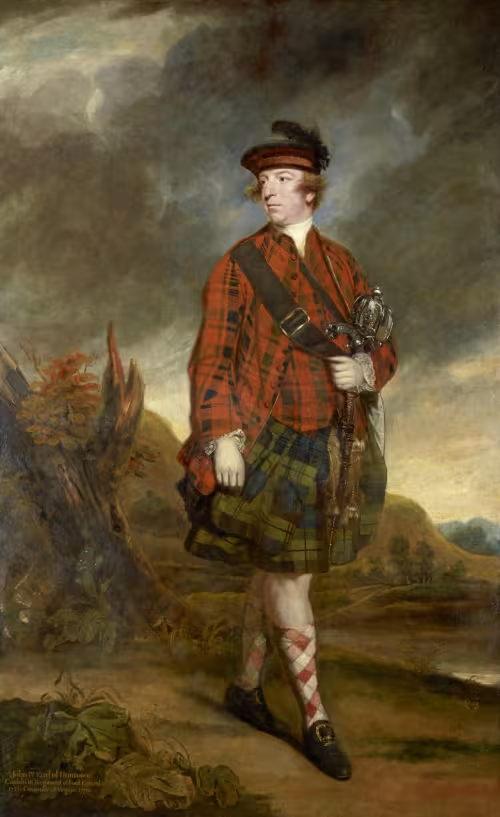
John Murray, 4th Earl of Dunmore
John Murray, 4th Earl of Dunmore
Colonial governor whose 1775 promise of freedom to enslaved people who joined British forces and attempts to suppress Virginia rebels hastened revolution.
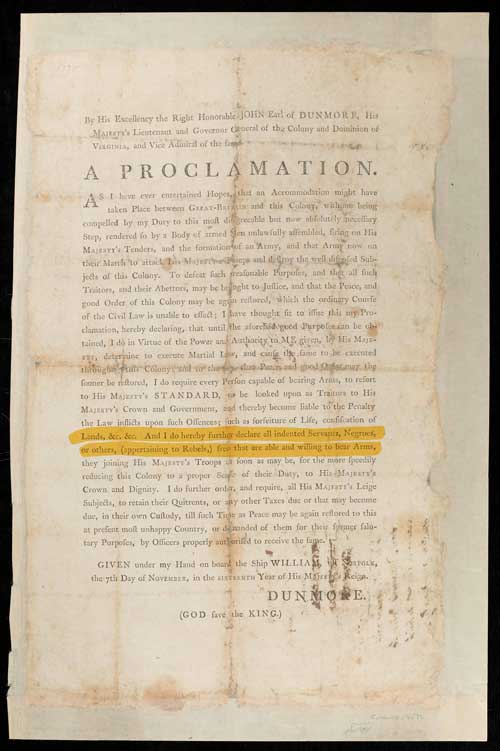
With this November 1775 proclamation, the Virginia Royal Governor “declare[d] all indented Servants, Negroes, or others, (appertaining to Rebels,) free that are able and willing to bear Arms.”
General Sir Henry Clinton issued in June 1779 the Philipsburg Proclamation, which promised protection and freedom to any enslaved person who could reach British lines, regardless of whether they fought. These proclamations offered enslaved people a direct route to freedom, and they inspired thousands to turn to the British.
Yale Center for British Art, Paul Mellon Collection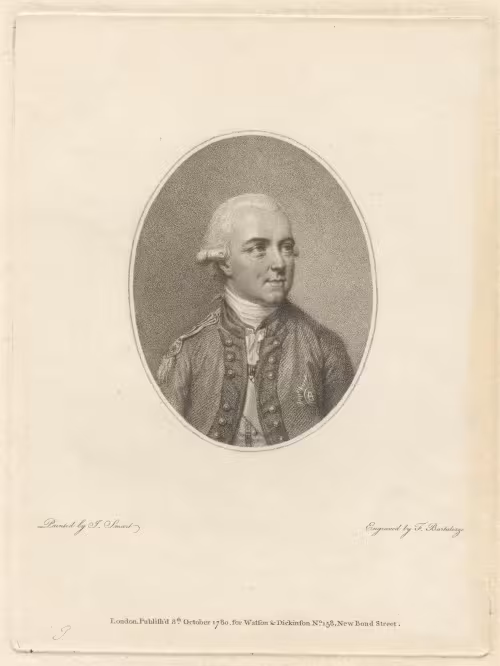
Henry Clinton
Henry Clinton
British commander in America whose Charleston siege victory was overshadowed by missteps that contributed to the decisive Yorktown defeat.
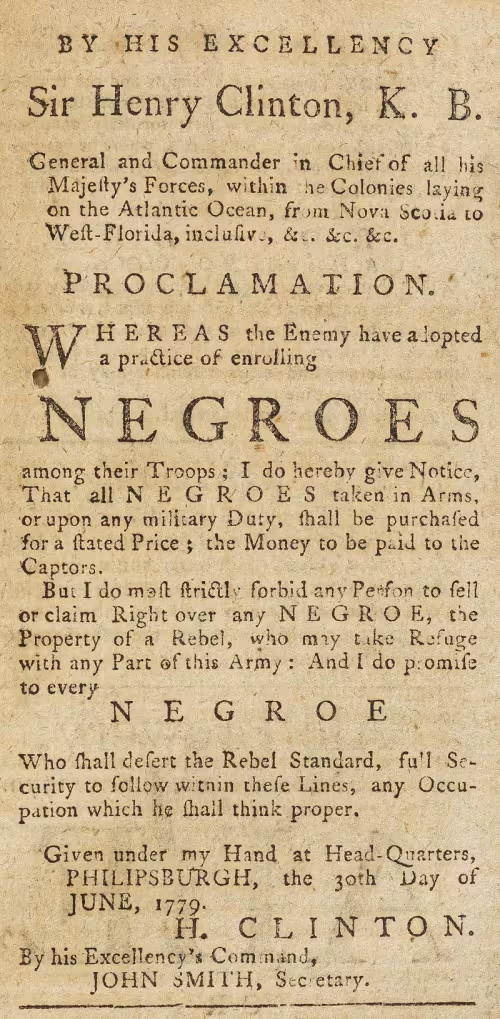
Philipsburg Proclamation, 30 June 1779
Philipsburg Proclamation, 30 June 1779
British General Henry Clinton promises freedom and work to enslaved people who desert the Continental Army for British lines.
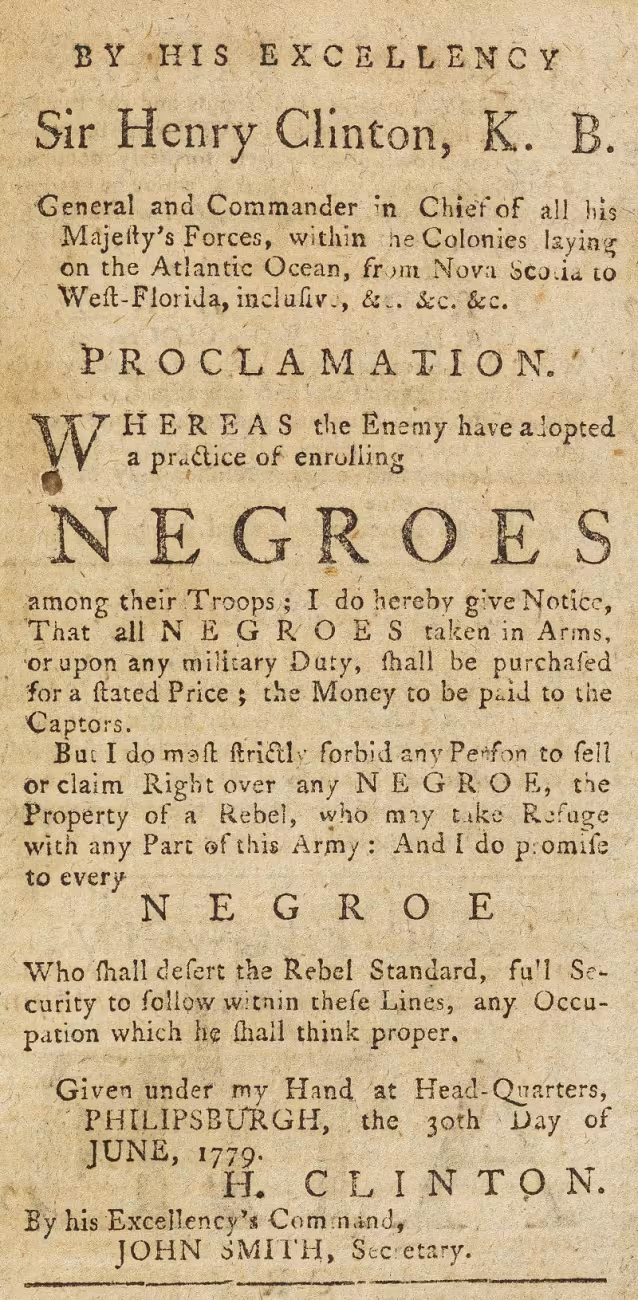
With this June 1779 proclamation, General Clinton promised protection and freedom to any enslaved person who could reach British lines, regardless of whether they fought.
Boston King's Escape
When the British Army occupied parts of the American South, thousands of enslaved people sought freedom by escaping to British lines. Boston King was one of them. In his memoir, he recalls the dangers of slavery, his decision to escape, and the hope he found in choosing liberty.
Boston King's Escape Related Content
Boston King
Boston King
Black Loyalist who escaped slavery during the American Revolution and became one of the first Black Methodist missionaries in Sierra Leone.
Extract from Boston King's Memoirs, 4 June 1796.
Extract from Boston King's Memoirs, 4 June 1796.
But he quickly learned that British protection was not a paradise. The camps were squalid, overcrowded, and ravaged by disease. King was one of many who contracted smallpox, narrowly surviving a sickness that killed thousands of other refugees.
Once recovered, King proved his “inestimable value.” A carpenter by trade, he lacked tools in the chaos of war and worked as a servant and laborer. But his real contribution was on the battlefield. King became a daring “express carrier,” once slipping through enemy lines to deliver dispatches that saved 250 British soldiers from a Patriot ambush. He even served on a British man-of-war, helping to capture a rebel ship in the Chesapeake Bay.
Between Freedom and Danger
King’s story reveals the challenges Black people faced. He was captured and re-enslaved, only to escape a second time to the British. He also had to look over his shoulder at his own allies: innumerable runaways were betrayed and sold back into slavery by corrupt Loyalist militia officers. King himself was once seized by a Loyalist captain and nearly sold, escaping only through his own wits.
By 1782, King had moved to New York City with his wife, Violet, a fellow runaway from North Carolina who was 12 years his senior.
Violet King
Violet King
Escaped slavery in North Carolina, evacuated to Nova Scotia in 1783, and likely influenced her husband Boston King's conversion to Christianity.
Their hard-won peace was shattered when the preliminary peace treaty was published. Article 7 required the British to return all American property, including enslaved people. At this breaking point, British commander Sir Guy Carleton made a historic choice.
Library and Archives Canada / Acc. No. 1997-8-1 / e011165560. View in the Collections of the Library and Archives of Canada.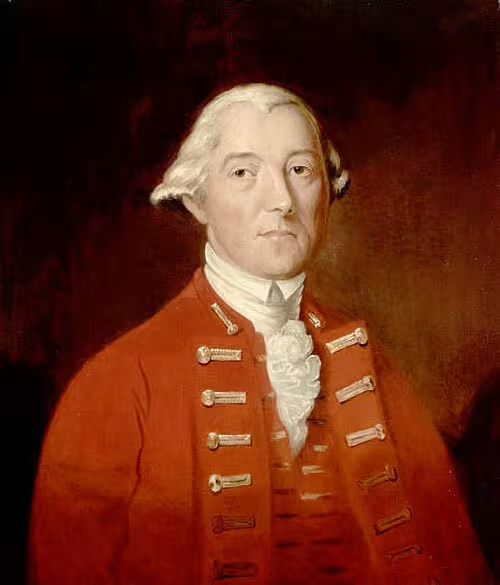
Guy Carleton
Guy Carleton
British general who defended Quebec from the Continental Army in 1776 and later oversaw the evacuation of British forces and Loyalists from New York City.
He interpreted the treaty to mean that any Black person who had reached British lines before the peace was signed was already legally free and no longer "property."
At War's End
To protect them, the British issued thousands of “Birch Certificates,” slips of paper guaranteeing their freedom.
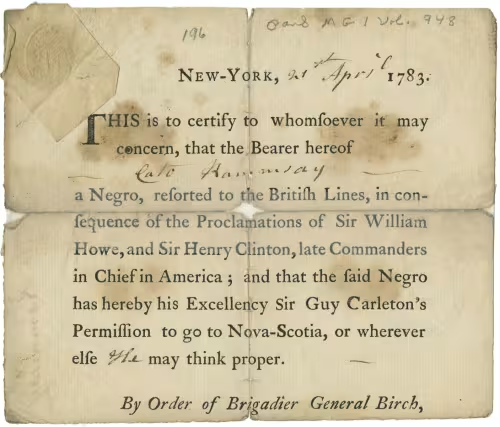
Passport for Cato Ramsey, 21 April 1783
Passport for Cato Ramsey, 21 April 1783
This 1783 British passport documents Cato Ramsey's self-emancipation during the Revolution and his resettlement in Nova Scotia under British protection.
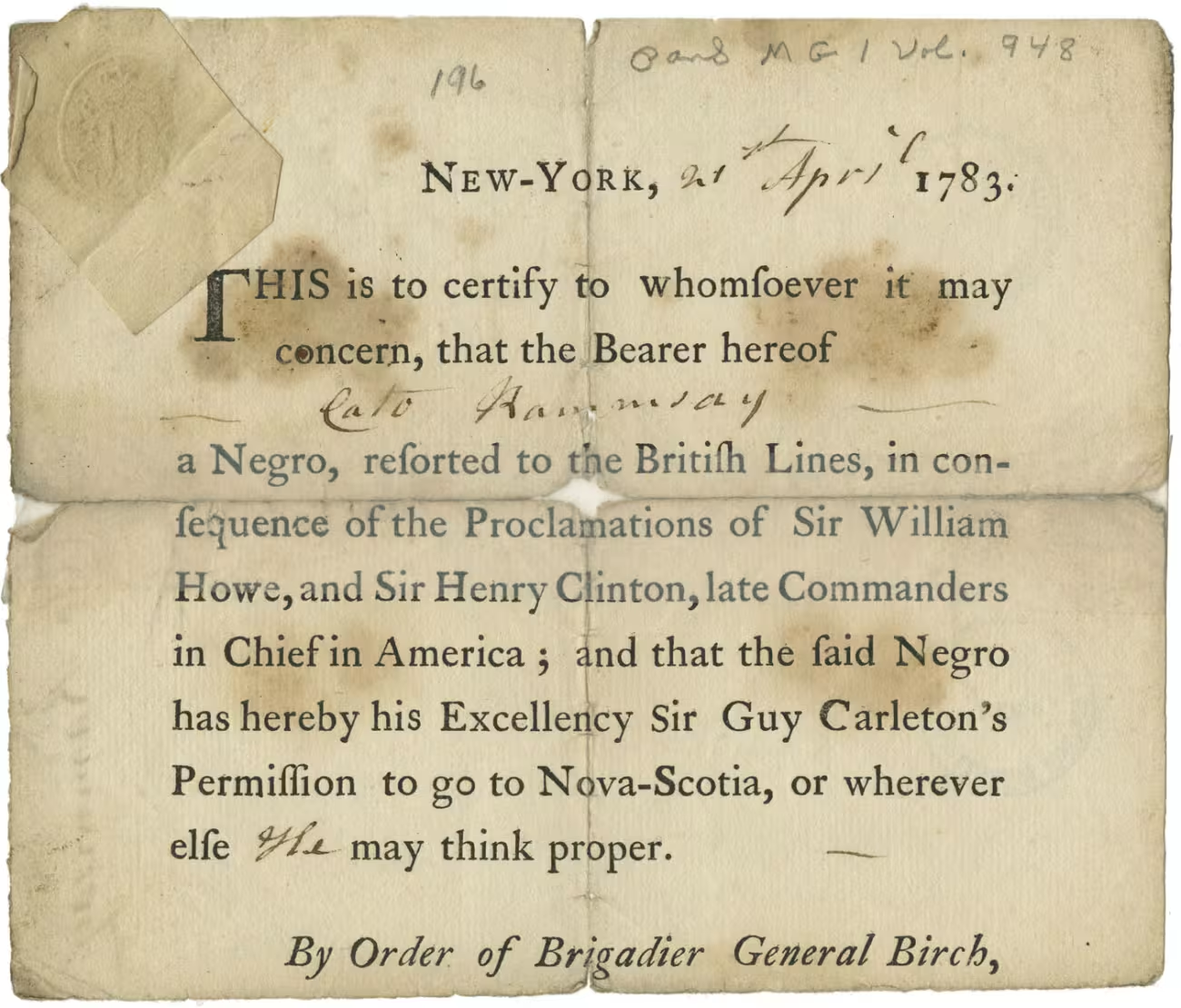
This passport belonged to Cato Ramsay, allowing him to immigrate to Nova Scotia. Ramsay gained his freedom by escaping to the British lines, which would have been a risky venture.
Following the close of the Revolutionary War, negotiations between the Americans and British determined that any formerly enslaved individuals who had escaped to British lines, should remain free. The names of these individuals were officially documented in the “Book of Negroes.” Boston King is one of 3000 Black Loyalists whose name is listed in the record.
Boston King was described in the ledger as a “Stout fellow, aged 23.”
On 31 July 1783, he and Violet boarded the ship L’Abondance and sailed for Port Roseway (Shelburne), Nova Scotia.
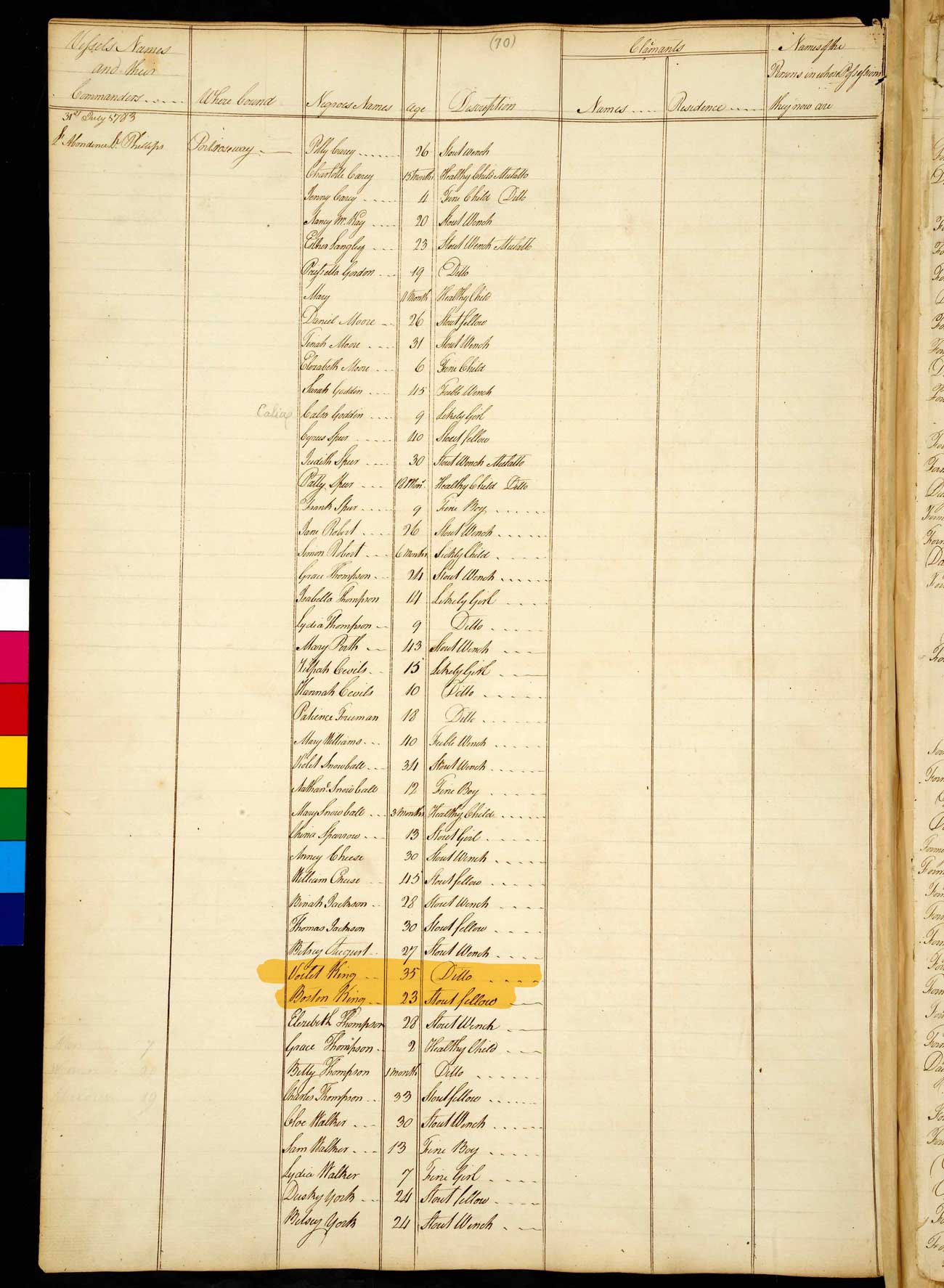
Following the close of the Revolutionary War, negotiations between the Americans and British determined that any formerly enslaved individuals who had escaped to British lines, should remain free. The names of these individuals were officially documented in the “Book of Negroes.” Boston King is one of 3000 Black Loyalists whose name is listed in the record.
King described the situation:
“Memoirs of Mr. Boston King,” Methodist Magazine 21 (1798): p. 107.
“Memoirs of Mr. Boston King,” Methodist Magazine 21 (1798): p. 107.
King had gambled his life on the British Crown. He had survived smallpox, naval battles, and the betrayal of his own officers. His rejection of the American Revolution gave him the one thing the Declaration of Independence had denied him: freedom. He eventually settled in Sierra Leone, where he served as the first Methodist missionary to African people.