
The Declaration of Independence: America's Founding Shared Document
Produced by ClickView for forgingUS, a project of the Center for Digital Editing at the University of Virginia. © 2026 The Rector and Visitors of the University of Virginia. All rights reserved.
This film explores the creation of the Declaration of Independence as a collaborative process rather than a single finished work. In 1776, amid the Revolutionary War, the Continental Congress sought to justify independence to both colonists and the global community. Thomas Jefferson drafted the initial document, outlining colonial principles and grievances against Britain. A committee of five reviewed and edited his draft, followed by extensive debate and revisions by Congress. Significant changes—including the removal of a passage condemning the slave trade—highlight the compromises required for unity. After approval on July 4, 1776, the document was rapidly printed and distributed by John Dunlap. Shortly thereafter, Timothy Matlack produced the formal handwritten version, signed by delegates on August 2. Surviving drafts reveal the intense negotiation and urgency behind the document, illustrating how collaboration shaped one of the most influential texts in American history.
Want to know more?
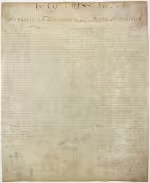
This foundational document declares American independence from Britain and outlines the grievances that led to this break.
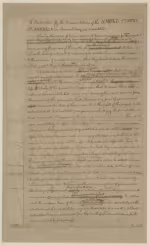
This rough draft of the Declaration of Independence features early revisions by Adams and Franklin and several sections ultimately removed by Congress.
People
Printer of the first published copies of the Declaration of Independence in 1776 and publisher of the Pennsylvania Packet during the Revolution.
British monarch who reigned for six decades, overseeing Britain's loss of American colonies and the defeat of Napoleon, while battling mental illness.
The only signer of all four founding documents and architect of the Connecticut Compromise that established the bicameral structure of Congress.
Co-drafted the Declaration of Independence, worked on the first New York State constitution, and negotiated the Louisiana Purchase as minister to France.
Lawyer who defended British soldiers after the Boston Massacre, championed independence in Congress, and served as the second U.S. president.
Helped draft the Declaration of Independence and worked to secure the crucial Franco-American alliance that changed the course of the Revolution.
A prominent early-American politician who drafted the Declaration of Independence and served as the third U.S. president.
Organizations
Led the U.S. government prior to the Articles of Confederation, created the Continental Army, and issued the Declaration of Independence.
Drafted the Declaration of Independence. Its members were: Thomas Jefferson, John Adams, Benjamin Franklin, Roger Sherman, and Robert R. Livingston.